Blog Content

9
Jun
2026
The cost to have a fence stained typically falls between $1.33 and $2.71 per square foot in 2026, depending on your fence size, wood type, stain choice, and local labor rates.
Here's a quick snapshot of what most homeowners pay:
Your wood fence is one of the biggest investments in your yard. But without protection, sun, rain, and moisture slowly break it down — fading the color, warping the boards, and inviting rot.
Staining is the most effective way to stop that damage. It soaks into the wood, seals it from moisture, and blocks UV rays. The result: a fence that looks better and lasts years longer.
But how much does it actually cost to get the job done right? The answer depends on several factors — fence size, stain type, prep work needed, and where you live. This guide breaks it all down clearly so you can budget with confidence.
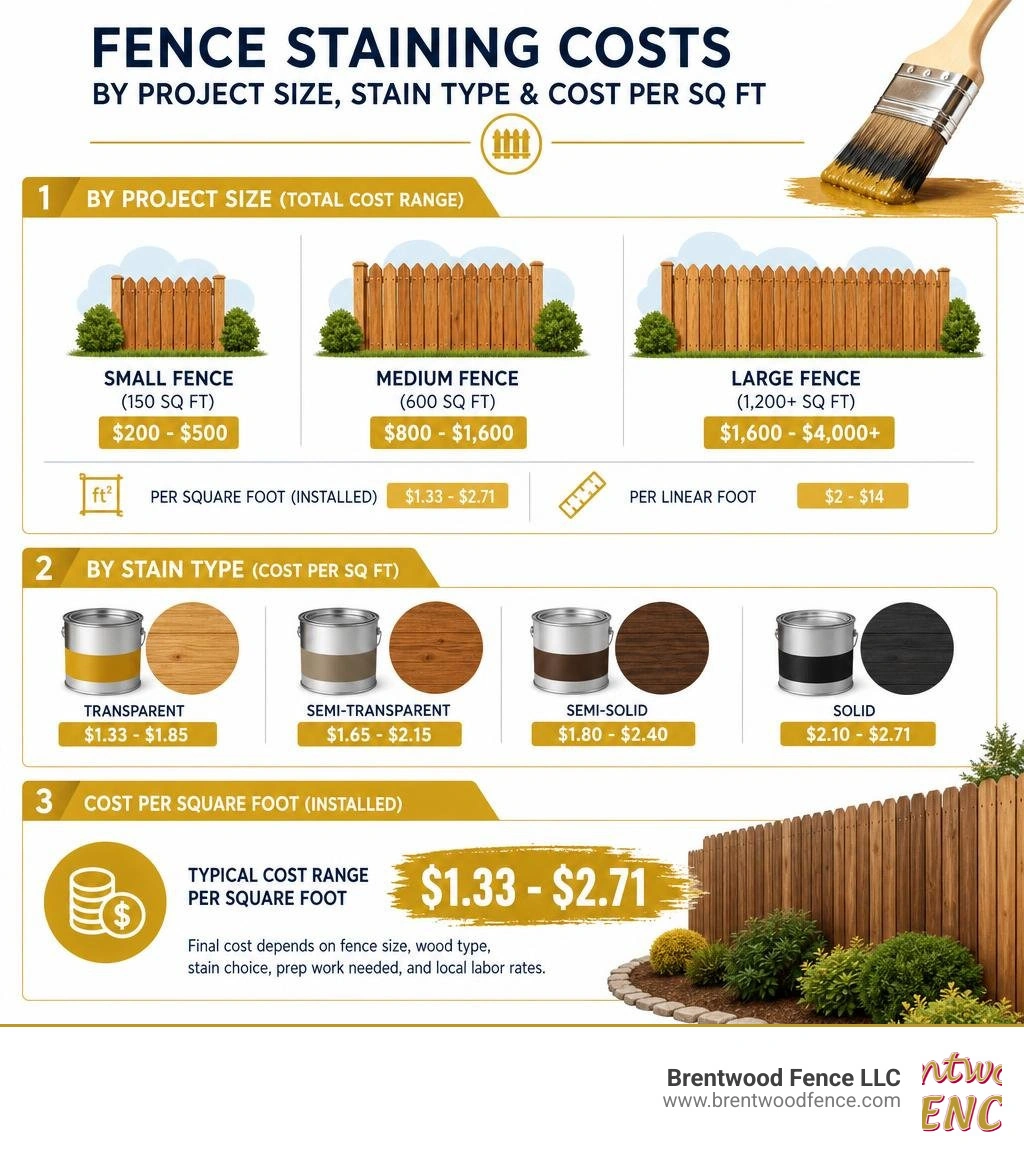
When you start planning a fence staining project in New England, you will quickly find that pricing is highly dependent on how your contractor calculates the job. Most professional companies in New Hampshire, Massachusetts, and Maine charge either by the square foot or by the linear foot.
According to the HomeGuide Fence Staining Cost Guide, the national average range to paint or stain a fence sits between $1,000 and $4,000. Most homeowners pay right around $2,000 to stain both sides of a 209-linear-foot, 6-foot-high privacy fence (which covers a typical quarter-acre yard).
Let’s look at the two primary pricing methods:
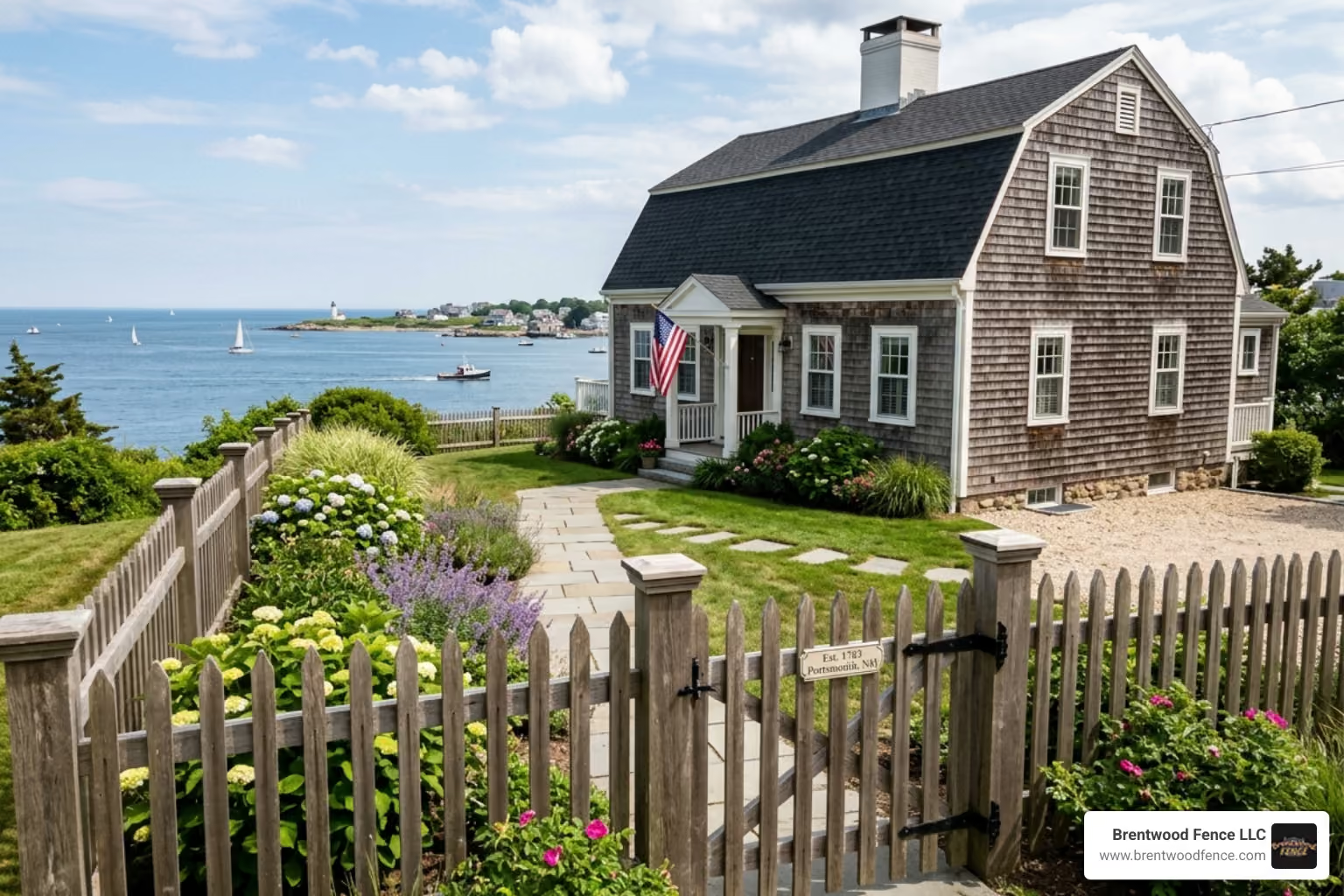
While national averages give us a great starting point, your actual project size will ultimately dictate where you land on the pricing scale. A small decorative picket fence in Portsmouth, NH, will naturally require a much smaller budget than a sprawling privacy boundary in Haverhill, MA.
To get a highly customized estimate based on your specific yard size and localized materials, you can use the Homewyse Fence Staining Calculator.
Generally, residential projects fall into these three brackets:
The type of wood your fence is built from plays a massive role in how much stain it will absorb, which directly impacts your material costs.
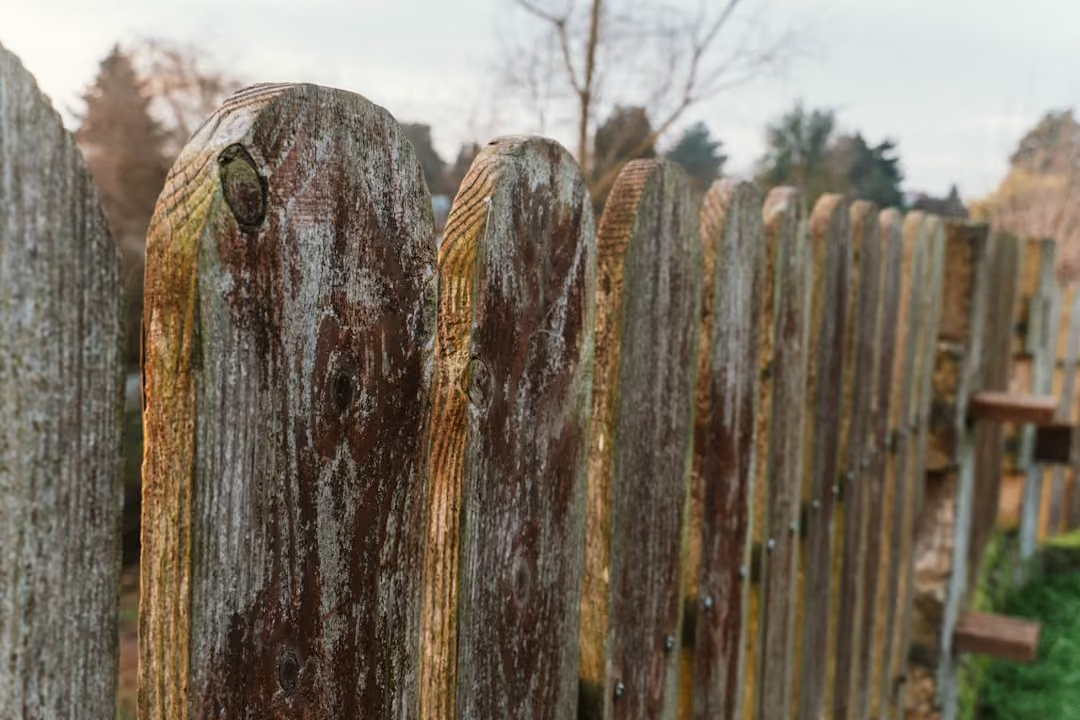
Beyond the wood species, the current condition of your fence is the ultimate wild card. If you are staining a brand-new, clean fence, the labor is straightforward. But if you have an older fence covered in gray weathered fibers, green mold, or peeling old paint, your contractor will need to spend hours prep-washing, scraping, and sanding. This heavy restoration work can easily double the labor cost of the project.
To understand where your hard-earned money goes, it helps to break down a professional quote into its core components: materials, labor, and prep work.
The chemical composition of your chosen stain dictates both its price tag and how long it will protect your wood.
Coverage Rates: On average, one gallon of quality stain will cover 150 to 300 square feet of rough-sawn wood. If the wood is smooth, planed cedar, a gallon might stretch up to 400 square feet. Because rough wood is highly absorbent, you should always budget for more stain than you think you need.
Labor makes up the largest portion of your professional fence staining bill. Professional painters typically charge between $40 and $60 per hour, or a flat rate of $0.30 to $0.70 per square foot just for the application labor.
However, a beautiful finish is 90% preparation. If your fence needs some TLC before the first drop of stain is applied, expect these add-ons:
Estimating your budget doesn't require a degree in advanced mathematics. With a simple tape measure and a notepad, you can calculate a highly accurate estimate of your staining expenses.
To find your total square footage, follow this simple formula:
$$\text{Length of Fence (in feet)} \times \text{Height of Fence (in feet)} = \text{Square Footage of One Side}$$
If you want to stain both sides of the fence (which we highly recommend to prevent uneven moisture warping), simply multiply that number by 2.
Once you have your total square footage, divide it by the average coverage rate of your stain (usually 200 sq. ft. per gallon) to determine how many gallons you need to purchase. To learn more about how fence dimensions translate to installation and maintenance costs, check out our guide on wood fence cost per linear foot.
Labor rates vary significantly across the United States, and New England is no exception.
Local rates also vary by town. For example, historical data shows slight differences in nearby communities; you can explore local pricing trends via resources like Fence Painting in Concord, NH - Costs 04 / 2026 - Homeyou and Fence Painting in Derry, NH - Costs 03 / 2026 - Homeyou.
When your fence starts looking tired, you have a few paths forward. You can tackle the staining yourself, paint it, or, if it is past its prime, replace it entirely.
At first glance, staining your own fence seems like a great weekend project. But let's look at the real math:
While DIY saves money upfront, it requires a massive time commitment. A standard backyard fence can easily take an inexperienced homeowner 3 to 4 full days of back-breaking work (washing, drying, taping off plants, and applying multiple coats).
Furthermore, professional crews use commercial sprayers that apply stain with perfect uniformity. They know how to handle tricky wood conditions, and their work typically comes with a warranty. If you decide you'd rather start fresh with a professionally built boundary, contacting a local wooden fence installation expert is your best bet.
Should you paint or stain? And when is it time to just tear it down?
In the damp, snowy climate of New England (especially near coastal areas like Portsmouth, NH), you should plan to restain your fence every 2 to 4 years. Transparent stains need attention every 1 to 2 years, while premium semi-transparent and solid stains can easily last 3 to 5 years. You can use the "water bead test": splash some water on your fence. If it beads up, your wood is protected. If it soaks right into the wood, it's time for a fresh coat!
No! Brand-new pressure-treated wood is saturated with chemical preservatives and moisture. If you stain it immediately, the wood will reject the stain, leading to a splotchy, peeling mess. You must let the wood "weather" and dry out completely. This typically takes 60 days of warm, dry weather.
It can if done incorrectly. Using too much pressure (PSI) will shred the delicate wood fibers, leaving your fence looking fuzzy and ruined. When prepping a fence, professionals use a wide-angle nozzle, low pressure (under 1,500 PSI), and specialized wood cleaners to gently lift mold and dirt without gouging the wood.
Protecting your fence doesn't have to be a stressful guessing game. While the cost to have a fence stained represents an upfront investment, it is only a fraction of the cost of replacing a ruined, rotted fence just a few years down the road.
At Brentwood Fence LLC, we help homeowners across New Hampshire, Massachusetts, and Maine protect their outdoor investments. Whether you need professional repairs to get your old fence ready for stain, or you are looking to build a brand-new, gorgeous cedar boundary, we are here to help.
Ready to transform your yard? Explore our professional wood fencing installation services and request your free estimate today!

Copyright 2022 Brentwood Fence | All Rights Reserved | Sitemap | Website by Plumb Development a Digital Marketing Agency