Wood Privacy Fence Guide: Panels, Costs, and Installation Tips
8
Jul
2026
Author:
Rob Thibeault
Why a Wood Privacy Fence Is Still the Top Choice for Homeowners
A wood privacy fence remains one of the most popular investments a homeowner can make — and for good reason. Wood fencing accounts for roughly 35% of the residential fencing market in the United States, with millions of homeowners choosing it every year for backyard privacy, curb appeal, and property security.
A solid or semi-solid fence made from wood boards or panels, typically 6 feet tall
Designed to block sightlines, reduce noise, and define property boundaries
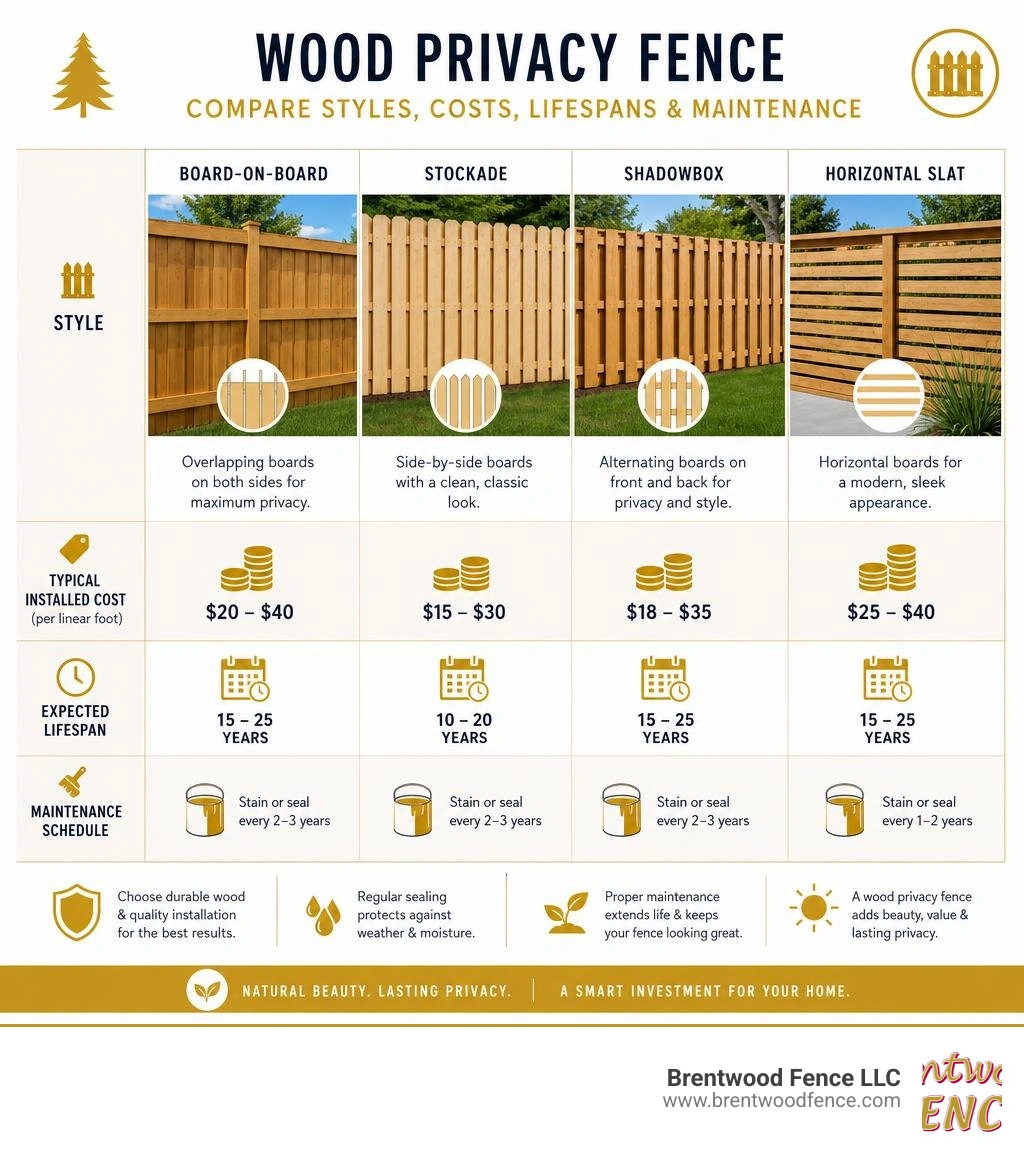
Common styles include board-on-board, stockade, shadowbox, and horizontal slat
Popular wood species include cedar, pressure-treated pine, and redwood
Professionally installed cost typically runs $15–$40 per linear foot depending on wood type and style
Expected lifespan ranges from 10 to 25 years depending on material and maintenance
Wood fences have a warmth and natural beauty that vinyl or metal simply can't match. They're also highly customizable — you can paint, stain, or leave them natural, and cut or shape them to fit nearly any yard layout.
But not all wood fences are created equal. The wood species you choose, the style of panel, and the quality of installation all have a huge impact on how long your fence lasts and how much it costs to maintain.
This guide covers everything you need to make a confident decision: styles, materials, costs, and what to expect from professional installation.
Popular Styles and Designs of a Wood Privacy Fence
When selecting a wood privacy fence for your New England backyard, the style you choose dictates both the aesthetic vibe of your property and the level of seclusion you will enjoy. Different construction methods offer varying degrees of airflow, visual block, and structural resilience.
Here in the Northeast, where we experience heavy snow loads, high winds, and humid summers, choosing the right style is crucial. Let's break down the most popular options we install for homeowners seeking the perfect blend of form and function. You can explore these in greater depth in our guide on the Types of Wood Privacy Fences NH MA ME.
Board-on-Board Fencing: This is the gold standard for complete, 100% privacy. Pickets are applied in an overlapping pattern on both sides of the horizontal rails. Because the boards overlap, there are absolutely no gaps for neighbors to peek through, even as the wood naturally shrinks and expands over time. It requires roughly 30% more pickets than standard designs, making it heavier and slightly more expensive, but the structural depth and total privacy are unmatched.
Shadowbox Fencing: Often referred to as a "neighbor-friendly" fence, the shadowbox style alternates pickets on the front and back of the rails. This creates a beautiful, identical look from both sides of the property line. While it blocks direct head-on views, it does allow for angled visibility. The main advantage of shadowbox in New England is its high airflow; wind passes through the gaps easily, reducing the physical strain on your posts during coastal nor'easters.
Stockade Fencing: A classic, budget-friendly option. Stockade fences feature pickets with pointed tops (resembling historic fort barriers) placed tightly side-by-side. While traditional and highly secure, stockade panels offer less dimensional depth than board-on-board and can develop minor gaps as the wood seasons.
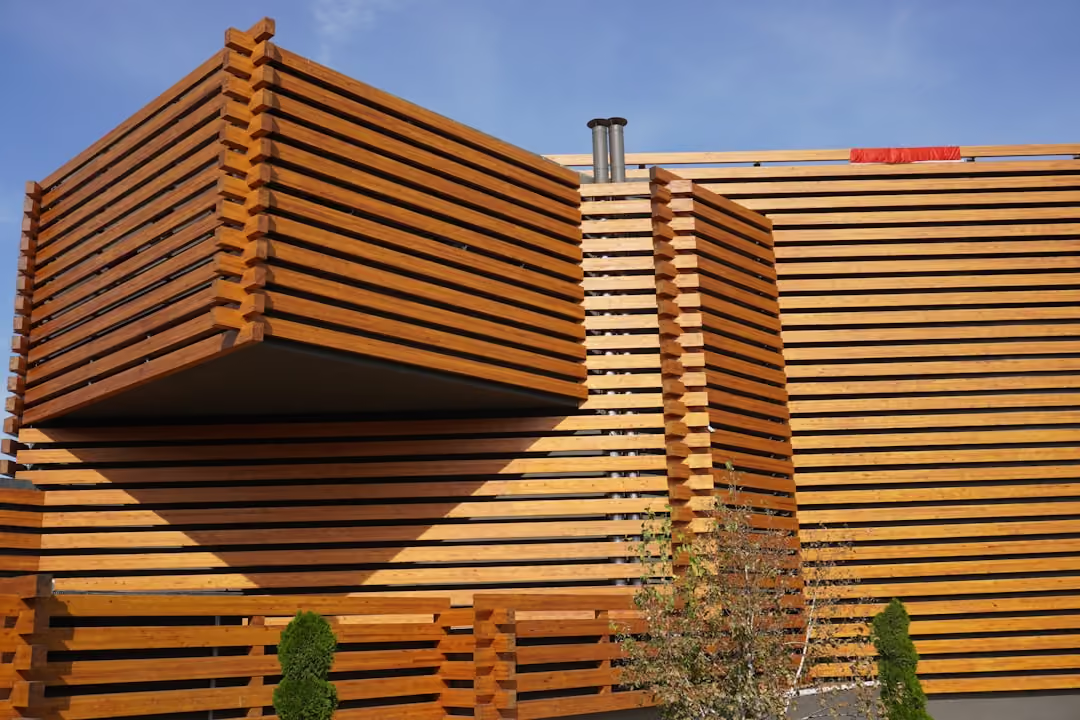
Horizontal Slat Fencing: For a clean, contemporary look, horizontal slats are soaring in popularity. Instead of vertical pickets, boards run horizontally between the fence posts. This style emphasizes the width of your yard and pairs beautifully with modern architectural designs. However, horizontal fences require incredibly precise installation to prevent the long boards from sagging over time.
Lattice-Top Fencing: If you want privacy but don't want your backyard to feel like a fortress, a lattice-top fence is the perfect compromise. This design features a solid lower section (usually 5 feet of solid wood pickets) topped with a 1-foot decorative diagonal or square lattice panel. It lets in natural light and breeze at the top while keeping your yard secure below.
Solid Wood Privacy Fence Panels
For homeowners who prioritize absolute seclusion, solid panel designs are the ultimate solution. Standard solid panels typically utilize 6-foot-high pickets attached flush against one another.
To prevent the bottom of your pickets from wicking up ground moisture and rotting prematurely, we always recommend keeping them elevated at least 1.5 inches off the grass or soil.
When building a high-quality solid fence, there are two primary design components to consider:
Picket Tops: The most common options are classic dog-ear pickets (where the top corners are clipped at an angle) and flat-top panels. Dog-ear tops help shed water away from the end grain of the wood, while flat-top panels offer a cleaner, more uniform line across the horizon.
Post Details: You can choose to have your fence posts completely hidden behind the solid panels for a continuous wooden wall effect, or opt for exposed gothic or chamfered decorative posts to break up the visual span.
While many big-box stores sell preassembled solid panels, we prefer component-built installation (building the fence piece-by-piece on-site). On-site construction allows us to custom-fit the fence to the unique contours of your yard, preventing ugly gaps at the bottom. For a detailed technical look at how component fences are engineered, you can review these Step-by-Step Instructions: Building a 6-Foot Redwood Privacy Fence.
Modern Backyard Privacy Design Trends
The days of boring, cookie-cutter backyards are long gone. Today's New England homeowners are treating their outdoor spaces as true extensions of their indoor living areas. If you are looking for design inspiration, check out our curated Privacy Fence Ideas NH MA ME and our deep dive into modern Backyard Privacy Design.
Currently, we are seeing several exciting trends dominate the residential landscape:
Dark Stains and Black Fences: Applying a rich charcoal, dark gray, or solid black stain to a wood privacy fence creates an incredibly sophisticated backdrop. Dark colors make green foliage and colorful garden beds pop visually, while also making the boundaries of your yard seem to recede, creating the illusion of a larger space.
Mixed-Material Fencing: Combining natural wood pickets with sleek black aluminum posts or metal frames provides a striking industrial-modern aesthetic. The metal elements add immense structural rigidity while the wood retains its organic warmth.
Integrated Lighting and Planters: Homeowners are increasingly adding low-voltage cap lights to their fence posts to create a warm evening ambiance. Hanging vertical planter boxes or training climbing vines along a sturdy lattice-top fence are also fantastic ways to soften the hardscape and introduce lush texture.
Wood Species, Materials, and Weather Performance
Choosing the right wood species is the single most important factor in determining how your fence will look, how much maintenance it will require, and how long it will survive the harsh New England elements. Our regional climate—defined by freezing winters, muddy springs, and humid summers—places extreme stress on outdoor wood structures.
To help you compare your options at a glance, we’ve compiled this breakdown of the most common fencing materials:
Wood Species / Material
Average Lifespan
Maintenance Level
Relative Cost
Natural Appearance & Characteristics
Northern White Cedar
15–25 Years
Low to Medium
Moderate to High
Beautiful light tan; tight grain; weathers to a classic New England silver-gray.
Pressure-Treated Pine
15–20 Years
Medium
Budget-Friendly
Greenish-yellow tint initially; prone to warping/twisting if not sealed properly.
Redwood
20+ Years
Medium
Premium
Rich reddish-brown; highly durable; less common and more expensive in the Northeast.
Spruce
8–12 Years
High
Very Low
Pale white; highly susceptible to rot and insect damage without constant sealing.
Wood-Plastic Composite
25+ Years
Low
High
Manufactured wood look; highly uniform; will not rot, warp, or split.
Cedar vs. Pressure-Treated Pine for a Wood Privacy Fence
In our service areas across New Hampshire, Massachusetts, and Maine, the debate almost always comes down to two main contenders: Cedar and Pressure-Treated (PT) Pine. Let's look at how they stack up in real-world conditions. You can read more about these materials in our overview of Wooden Fencing NH MA ME.
Cedar (The Gold Standard): Northern White Cedar is highly prized for its natural resistance to rot, decay, and boring insects. Unlike treated pine, cedar does not rely on chemical injections for its durability; its natural protective oils do all the work. Cedar is incredibly dimensionally stable, meaning it is far less likely to warp, cup, or twist as it dries. Over time, cedar exposed to the New England elements naturally weathers to a gorgeous, rustic silver-gray patina that looks highly intentional. If you prefer to keep its original warm color, it holds stains beautifully.
Pressure-Treated Pine (The Workhorse): PT pine is chemically treated under high pressure to resist fungal decay and insect attacks. It is highly durable and structurally strong, making it our preferred choice for the subterranean portion of fence posts. However, freshly cut PT pine has a distinct greenish-yellow tint that some homeowners find unappealing. Because pine absorbs a massive amount of liquid during the treatment process, it undergoes significant shrinkage and movement as it dries out in your yard, which can lead to warping or minor cracking.
A Note on "Checking": Many homeowners contact us worried when they notice small, vertical cracks developing along their cedar posts. This is a natural seasoning process called "checking." As the wood releases internal moisture, it shrinks and cracks slightly along the grain. Checking is purely cosmetic and does not affect the structural integrity or strength of the wood post.
Wood vs. Vinyl and Composite Alternatives
If you are torn between the timeless appeal of natural wood and the low-maintenance promises of modern synthetics, it helps to understand the trade-offs. We break down these differences in detail in our comparison of Yard Privacy Fencing Options NH MA ME.
Longevity: High-quality vinyl and wood-plastic composites can easily last 25 to 30+ years without rotting, whereas a standard wood fence will typically top out around 15 to 20 years, even with excellent care.
Maintenance: Vinyl and composites require virtually zero annual maintenance beyond a quick wash with a garden hose and mild soap. Wood, on the other hand, demands regular staining or sealing every few years to ward off moisture and UV damage.
Aesthetics: For many homeowners, synthetics simply cannot replicate the authentic warmth, unique grain patterns, and pleasant aroma of real wood. Additionally, if a vinyl fence gets damaged, replacing individual sections can be difficult and color matching older, sun-faded panels is nearly impossible. Wood is incredibly easy to repair; you can simply swap out a single damaged picket or rail and stain it to match.
Upfront Cost: Vinyl and composite systems carry a significantly higher initial price tag than traditional wood. While they can save you money on stain and labor over a 20-year period, wood remains the more accessible starting option for most household budgets.
When planning a home improvement project, understanding the financial investment is always a top priority. In 2026, we are seeing stable material costs paired with a strong demand for professional craftsmanship.
Generally speaking, a professionally installed wood privacy fence ranges from $15 to $40 per linear foot for standard materials and styles.
Several variables will influence where your project falls on this spectrum:
Wood Species: Spruce is the cheapest, pressure-treated pine sits in the middle, cedar is a premium option, and composite materials represent the highest tier.
Terrain and Slope: Flat, clear yards are quick and easy to fence. If our crews have to clear thick brush, navigate rocky New England soil, or build on a steep incline, labor costs will increase.
Layout Complexity: A simple rectangular backyard with few corners is highly cost-efficient. Yards with multiple gates, tight turns, or custom curves require more labor and hardware.
Average Cost of a 6-Foot Wood Privacy Fence
To give you a real-world scenario, let's look at the average costs to enclose a standard backyard requiring 150 linear feet of 6-foot-high wood privacy fencing.
Here is a breakdown of what a typical 150-linear-foot project looks like:
Pressure-Treated Pine (Budget-Friendly Option):
Estimated Cost: $3,000 to $4,500 (Installed)
Characteristics: Highly durable against insects and rot, but requires diligent sealing to prevent warping.
Northern White Cedar (Premium Option):
Estimated Cost: $4,500 to $6,800 (Installed)
Characteristics: Natural beauty, exceptional stability, and superior resistance to New England weather.
Additional Project Add-ons to Keep in Mind:
Gates: Standard 4-foot pedestrian gates typically add $200 to $400 each, while wider double-drive gates can run $500 to $800+ depending on the hardware.
Post Caps: Standard flat wood caps are highly affordable, but decorative copper or low-voltage solar LED caps can add $15 to $40 per post.
Staining/Sealing: If you hire a professional to apply a high-quality UV-protective stain after the wood cures, expect to add $1,000 to $2,000 to the total project cost.
Professional Installation vs. DIY
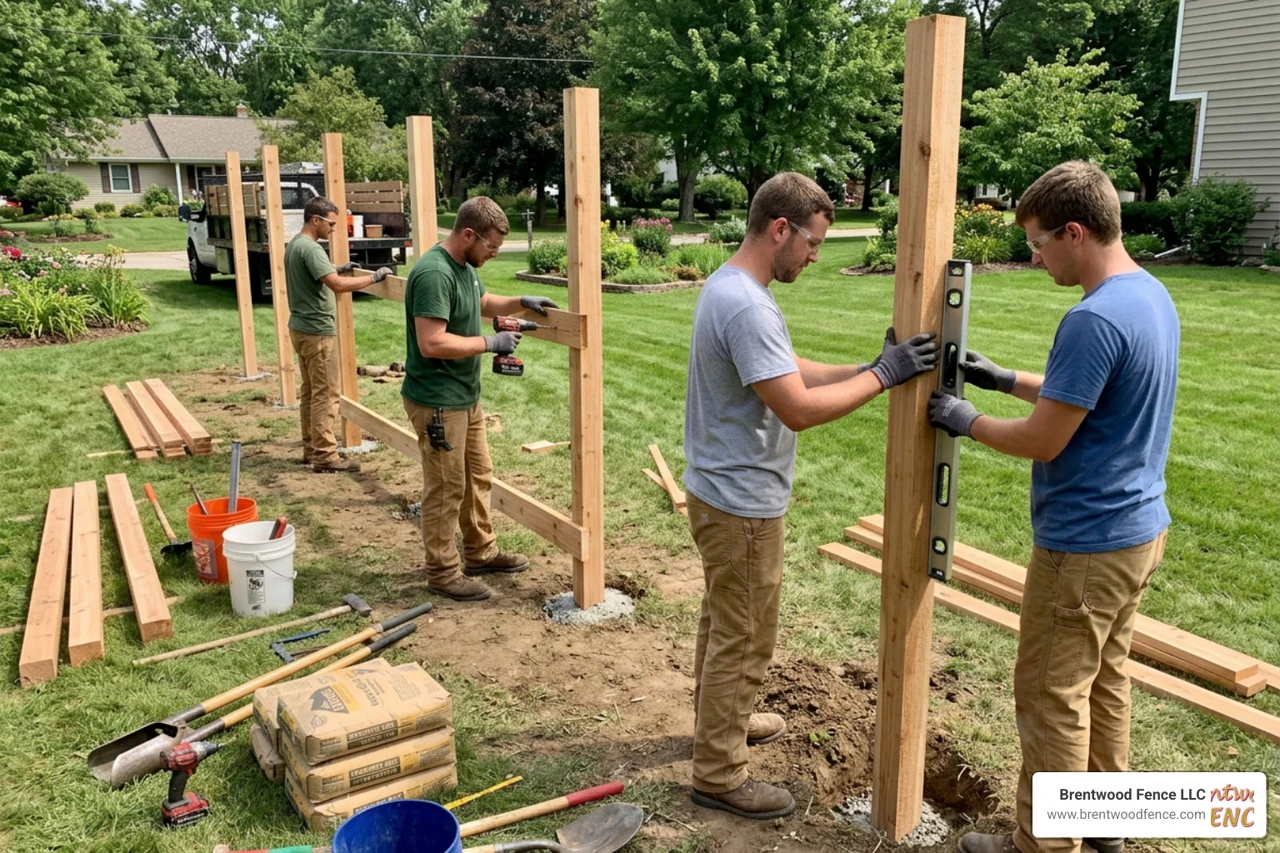
The internet is full of weekend-warrior tutorials claiming that building a wood privacy fence is a simple, stress-free DIY project. While it is certainly possible for a highly experienced homeowner with a truckload of specialized tools and a few strong friends to build a fence, the reality of New England soil and climate makes professional installation the safest and most durable choice.
The New England Frost Line: This is the single biggest failure point for DIY fences in our region. In New Hampshire, Maine, and Massachusetts, the ground freezes deep. If your fence posts are not set at least 36 to 48 inches deep (well below the local frost line) and anchored securely in concrete, the freeze/thaw cycle will physically push your posts out of the ground. This is known as "frost heaving," and it will ruin a fence in just one or two winters. Our professional crews know exactly how deep to dig and how to slope the concrete at the surface to shed water away from the wood.
Locating Underground Utilities: Digging dozens of deep holes in your yard without knowing what lies beneath is incredibly dangerous. We handle the entire utility marking process (calling 811) before a single shovel touches your dirt, ensuring we don't sever water, gas, or electrical lines.
Property Line Disputes: Building a fence even a few inches over your property line can result in costly legal disputes with neighbors or municipal fines. We work closely with homeowners to ensure fences are placed precisely within your legal boundary lines.
Structural Integrity and Speed: A professional crew can typically complete a 150-foot privacy fence in two to three days. For a DIYer, this project can easily drag on for multiple weekends, leaving your yard and pets unsecured. We also use professional-grade, corrosion-resistant fasteners (hot-dipped galvanized or stainless steel) that won't leave ugly black rust streaks down your beautiful wood panels.
Installing Wood Fences on Slopes and Uneven Ground
Very few backyards in New England are perfectly flat. If your property has rolling hills or a steep slope, installing a fence requires specialized techniques to ensure it looks level and functions properly.
There are two primary ways we handle sloped terrain:
The Racked Method (Contoured): In this style, the horizontal rails follow the natural slope of the ground, meaning the top of the fence remains parallel to the earth. This keeps the bottom of the fence close to the ground, which is ideal for containing pets and children. However, it requires a component-built approach where each picket is cut and fastened individually.
The Stepped Method: In this style, each fence section is built completely level, like a series of stairs climbing up the hill. This creates a highly clean, structured look along the top line. The main drawback is that it leaves triangular gaps under the fence on the downhill side of each step, which may require adding custom bottom dirt boards or landscaping to block.
How long does a wood privacy fence typically last?
The lifespan of your fence depends heavily on the wood species used, the quality of the installation, and how well you maintain it.
Northern White Cedar: Typically lasts 15 to 25 years.
Pressure-Treated Pine: Typically lasts 15 to 20 years.
Untreated Spruce: Usually only lasts 8 to 12 years before rot sets in.To maximize your fence's lifespan, ensure your posts are set in concrete below the frost line, keep the bottom of the wood pickets clear of ground contact, and apply a high-quality sealant or stain every few years.
Do I need a permit or neighbor agreement before installing a fence?
In most New England municipalities (including Exeter, Portsmouth, Concord, Manchester, and Haverhill), you will need to secure a local building permit before installing a fence over 6 feet tall.
Always check your local town ordinances and HOA guidelines first, as some residential zones have strict rules regarding fence height, materials, and placement.
While you are not legally required to get your neighbor's permission to build a fence on your own property, it is always best practice to notify them beforehand out of courtesy.
How often should I stain or seal my wood fence?
We recommend staining or sealing your wood privacy fence every 2 to 4 years.
If you have a brand-new cedar fence, wait about 60 days before applying your first coat of stain to allow the natural moisture in the wood to escape.
If you have a pressure-treated pine fence, it may take several months for the wood to fully dry out before it can accept stain.To test if your fence is ready for sealer, splash a few drops of water onto the wood. If the water beads up, the wood is still too wet. If the water quickly soaks into the wood fibers, it’s ready for a fresh coat of protection!
Conclusion
A high-quality wood privacy fence is more than just a boundary line — it is an investment in your home’s security, visual appeal, and daily comfort. Whether you love the classic, rustic charm of Northern White Cedar or want the clean, modern lines of a horizontal slat design, we are here to bring your vision to life.
By choosing professional installation, you protect your investment from the harsh New England winters, avoid the headaches of DIY alignment, and ensure a beautiful, straight fence line that will stand proud for decades.
Ready to transform your backyard into a private, peaceful oasis? Let our experienced team handle the heavy lifting.
Explore our Privacy Fencing Installation Services and contact us today to schedule your free, on-site consultation and estimate. Let's build something beautiful together!