Blog Content

30
Jul
2026
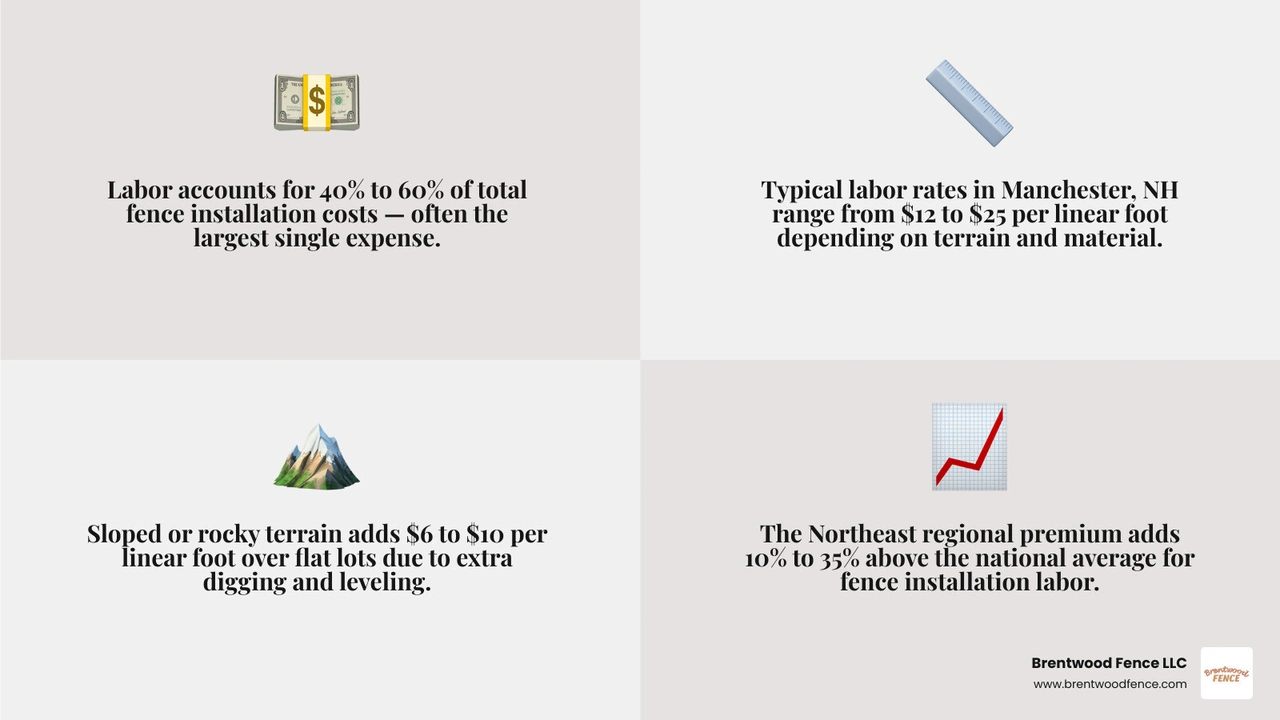
The labor rate for fence installation in Manchester, NH typically falls between $12 and $25 per linear foot, depending on your fence material, terrain, and project complexity. Here's a quick snapshot:
Labor consistently makes up 40% to 60% of your total fence installation bill — often the single largest line item on any quote.
That means on a typical 150-foot backyard fence project in Manchester, you could be looking at anywhere from $1,500 to over $3,500 in labor alone, before materials, permits, or gate work are factored in.
Most homeowners don't realize this until they're staring at a quote that feels higher than expected — and they have no way to tell if it's fair or inflated.
That's exactly what this guide is designed to fix. I'm Rob Thibeault of Brentwood Fence LLC, and I'll walk you through every factor that drives fence installation labor costs in the Manchester area so you can compare quotes with confidence.
Simple labor rate for fence installation glossary:
When you receive a quote for a new fence, the total price can feel like a single massive hurdle. However, breaking that quote down into its individual components is the key to understanding your investment. In 2026, labor remains the most significant and variable cost driver in a professional fence bid. Across most projects in New England, professional labor represents roughly 40% to 50% of the total installed cost.
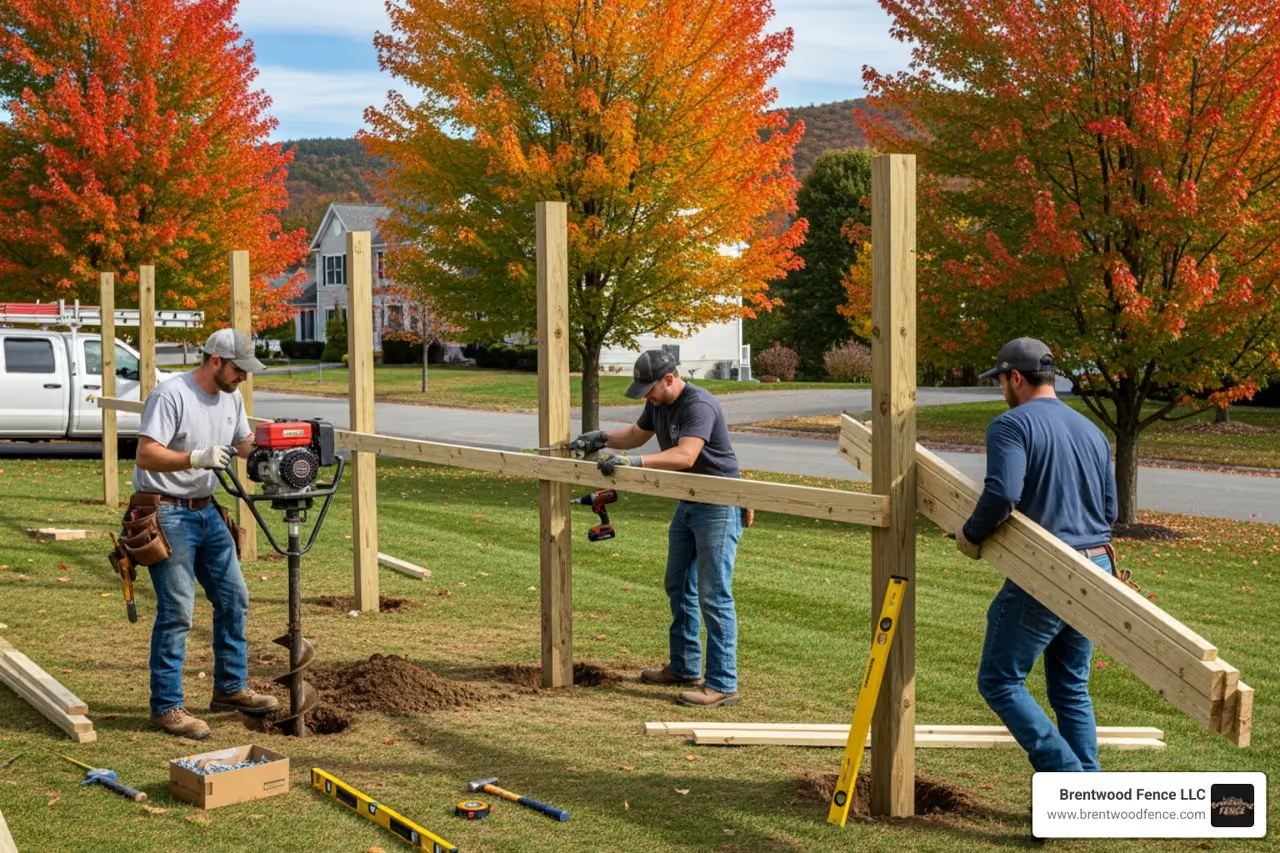
To understand where this money goes, we have to look at the daily operations of a professional crew. A typical residential fence crew consists of two to three skilled installers. On a standard suburban lot with flat ground and soft soil, this crew can set posts, secure rails, and hang panels for about 100 to 150 linear feet of fencing per day.
However, labor isn't just a flat rate. It is modeled from per-unit installed rates with a crew-rate sanity check. In 2026, a professional loaded billing rate ranges from $55 to $95 per crew-hour. This rate is informed by data from the Bureau of Labor Statistics (BLS) for Construction Laborers and Carpenters. It covers not just the physical act of digging and nailing, but also mobilization, safety equipment, cleanup, and the specialized tools required to complete the job correctly.

Geography plays an enormous role in determining your final estimate. The Northeast is known for its beautiful historic towns and challenging geological conditions, but it is also known for higher labor rates. According to the Cost to Install a Fence in 2026: Pricing Per Linear Foot, Northeast and West Coast markets run 20% to 35% higher than national averages. If you are planning a project in Manchester, Concord, Portsmouth, or Exeter, you should expect labor charges that reflect this regional premium.
To help visualize how regional multipliers and local terrain intersect, consider the table below:
Labor quality determines how your fence performs two years from now, not just how it looks on the day the crew packs up their trucks. Investing in a professional crew ensures that your posts are set deep enough to survive New England's harsh winters. For More details on New England fence costs, understanding these regional and operational baselines is the first step toward a successful installation.
A common misconception is that labor costs remain identical regardless of the material you choose. In reality, the material you select dictates the physical weight of the components, the complexity of the assembly, and the precision required during the layout phase. Some materials arrive as pre-assembled panels that can be quickly fastened to posts, while others require stick-building every individual picket on-site.
The physical properties of different materials also change how we install the underlying support system. Post spacing is a critical variable. Standard wood and vinyl fences typically feature posts spaced every 8 feet. Chain link fences can stretch post spacing to 10 feet, which reduces the total number of holes that must be dug. Conversely, heavy ornamental steel or custom wood designs may require tighter post spacing of 6 feet to handle wind loads or physical weight.
Each post must be secured in concrete to prevent leaning and shifting. Digging those holes and setting the posts in concrete adds roughly $40 to $90 per post in combined material and labor. If you are trying to estimate your baseline costs before speaking with a contractor, using an interactive tool like the Fence Cost Calculator (2026) can help you visualize how changing your material tier impacts both your material and labor budgets. For a broader overview of national and regional trends, check out our Average Fence Cost Per Linear Foot Guide.
To see how these materials compare in terms of installation complexity and labor cost, let’s look at the progression:
Wood and vinyl are the two most popular choices for residential privacy fencing in New Hampshire and Massachusetts. However, installing them requires distinct skill sets and labor times.
Wood fencing offers incredible versatility but requires significant on-site labor. If you choose a premium wood like Northern Red Cedar, the crew must carefully align every rail and picket to account for natural variations in the lumber. Standard pressure-treated pine is highly affordable but heavy, requiring physical stamina to handle. For a detailed breakdown of local pricing, see our guide on the Cost of wood fence installation in NH and the Cost Per Ft Wood Fence.
Vinyl, or PVC, presents a different labor challenge. While vinyl panels are lightweight and often slide together systematically, they require absolute perfection during the post-setting phase. If a wood post is off by a quarter of an inch, a carpenter can easily trim a rail to fit. If a vinyl post is off by a quarter of an inch, the pre-fabricated panel will not lock into place. This high demand for precision means vinyl labor rates typically range from $15 to $22 per linear foot.
Additionally, vinyl posts must be set deep to handle the "sail effect" of solid privacy panels during New England windstorms. To learn more about what to expect on your final invoice, review the Cost to have vinyl fence installed and see our Vinyl Fencing Price Per Foot guide.
If you are looking for maximum durability or a high-end modern aesthetic, metal and composite materials represent the premium tier of fence installation.
Aluminum fencing is highly valued in coastal areas like Portsmouth and Portland because it will not rust. It is lightweight, which makes transport easy, but setting the posts requires extreme care to avoid scratching the powder-coated finish. Professional labor for aluminum typically runs between $18 and $25 per linear foot. You can read more about these projects in our breakdown of the Cost of aluminum fence installed in 2026.
Chain link remains the most budget-friendly option, with labor costs ranging from just $5 to $10 per linear foot. Because chain link uses driven metal posts and rolled fabric, an experienced crew can install up to 150 feet of chain link in a single day. However, adding vinyl privacy slats or selecting a color-coated vinyl finish can slightly increase the assembly time. For more on this durable option, see our resources on the Labor cost for chain link fence and the 6ft Chain Link Fence Cost.
Composite fencing, made from recycled wood fibers and plastic resins, sits at the top of the cost scale. Composite panels are incredibly dense and heavy, requiring at least two workers to lift and position every single section. The material must also be allowed to expand and contract with temperature swings, requiring specialized brackets and fasteners. Labor rates for composite installation reflect this complexity, often reaching $25 to $35 per linear foot.
If every backyard in Manchester were perfectly flat, clear, and filled with soft, loam soil, estimating fence labor would be simple. But New England yards are rarely so cooperative. Our regional geography introduces several site conditions that can quickly alter a standard labor estimate.
The most common labor disruptor is terrain. Fences installed on steep slopes cannot simply be run in a straight line; they must be "stepped" or "racked" panel by panel to follow the contours of the earth. This requires the installation crew to measure, cut, and align every post individually, which significantly increases the time spent on layout. A crew that easily sets 100 feet of fencing per day on a flat suburban lot can see their productivity drop to just 30 feet per day on a rocky New England slope.
Then there is what lies beneath the surface. New Hampshire isn't called the Granite State by accident. Digging post holes in Manchester, Derry, or Concord often means striking buried granite, heavy clay, or thick tree roots. When a manual post-hole auger hits a boulder, the crew must stop and extract the rock using heavy iron digging bars, or bring in specialized hydraulic equipment. If we have to drill through solid rock or asphalt, it can add an extra $15 to $30 per hole.
Furthermore, we must account for New England's frost line. To prevent "frost heave" — where freezing soil pushes posts out of the ground during the winter — we must dig post holes at least 3 feet deep (or one-third of the post’s total length) so they sit securely below the frost line.
Beyond the physical dirt, several logistical and structural factors act as hidden cost drivers:
For a comprehensive look at how these variables come together on a real-world invoice, consult the guide on How Much Does a New Fence Cost in 2026?. If you are planning a traditional wood project, you will also find our detailed article on the Cost of 6 ft cedar fence installation and our guide on 100 Ft Privacy Fence Cost highly useful.
In the Manchester area, the total cost to install a standard residential fence (including both high-quality materials and professional labor) generally ranges from $25 to $60 per linear foot.
If you choose a basic material like pressure-treated wood or galvanized chain link, your total cost will sit on the lower end of that spectrum ($15 to $35 per foot). If you opt for premium cedar privacy fencing, decorative aluminum, or low-maintenance vinyl, you should budget between $35 and $60 per linear foot.
These local figures align with the data found in the Fence Cost Per Foot: Price Guide for U.S. Buyers 2026. To see how these rates translate specifically to our local service areas, take a look at our regional guide on Fence cost per linear foot in NH, MA, and ME.
Global trade policies have a direct, measurable impact on the estimate you receive from a local contractor. As of 2026, Section 232 steel tariffs apply a 50% rate on imported mill products and fabricated parts. This has driven up the cost of raw steel, adding roughly 15% to 25% to the price of metal fencing, including chain link and ornamental steel.
Similarly, tariffs on Canadian softwood lumber (which sits around 21%) have added roughly 12% to 18% to the cost of wood fencing. Because Canada supplies roughly 25% to 30% of the softwood lumber used in United States construction, this tariff has significantly narrowed the historical price gap between premium wood and vinyl.
While these tariffs primarily impact material costs, they also affect labor indirectly. Because materials are more expensive, contractors must operate with tighter margins and higher risk, meaning they cannot afford to discount their labor rates.
Tackling a fence installation yourself can save you 40% to 50% on the total cost of the project by eliminating professional labor fees. For a small, simple project under 100 linear feet on flat ground using pre-fabricated wood panels, a DIY approach can be an excellent weekend project. You can use a Fence cost calculator to estimate your raw material costs to see if the savings fit your budget.
However, for larger projects, sloped yards, or complex materials like vinyl and aluminum, DIY savings are often offset by unexpected challenges. A professional installation requires specialized tools, including heavy-duty post-hole augers, concrete mixers, compound miter saws, and laser levels. Renting these tools for multiple weekends can quickly erode your savings.
More importantly, professional crews understand how to navigate local utility lines (always call 811 before you dig!), set posts below the New England frost line, and secure structural warranties that protect your investment for decades.
Understanding the labor rate for fence installation is the key to planning a successful, stress-free home improvement project. While materials define the look of your yard, it is the quality of the labor that ensures your gate swings smoothly, your posts stay straight through mud and frost, and your investment lasts for decades.
At Brentwood Fence LLC, we have spent years building high-quality residential and commercial fences across Manchester, Concord, Portsmouth, Exeter, and the surrounding communities. We pride ourselves on transparent, honest pricing, clear communication, and craftsmanship designed to withstand New England's toughest seasons.
If you are ready to take the next step and get an accurate, itemized look at what your specific project will cost, we are here to help. Contact us today to Get a Free Fencing Installation Estimate and let’s build something beautiful together.


Copyright 2022 Brentwood Fence | All Rights Reserved | Sitemap | Website by Plumb Development a Digital Marketing Agency